
Creative Experiences
Frequently Asked Questions
New in FY27
How much can I apply for?
All eligible creative experiences can apply for $2500. You can apply for $5000 only if your creative experience’s mission, values, and activities are primarily based in the arts, humanities, and sciences.
Eligibility: Creative Experiences
How do you define arts, sciences, and humanities?
As it relates to this program, Mass Cultural Council uses the following definitions:
THE ARTS are the creation of work in the crafts and performing, visual, media, folk, design, literary, and interdisciplinary arts. They also include the presentation and preservation of, and education about, works in these disciplines.
THE HUMANITIES are types of learning that deal with human values and aspirations, human thought and culture, language, and creativity. Examples include, but are not limited to, history, social studies, philosophy, criticism, and literature.
THE SCIENCES are limited to the cultural, interpretive, and educational expression of science and refers to types of learning that deal with nature, science, and technology in ways that explain how they relate to people’s lives. Some organizations that conduct this type of activity include aquariums, botanical gardens, nature centers, natural history museums, planetariums, and science centers.
The Agency takes a broad view of “arts, humanities, and sciences” and includes disciplines like fashion, competitive dance, magic shows, circus arts, balloon twisters, reenactments, sand art and ice sculptures and robotics. Public art, topiary or landscape art, and interior design may also be eligible types of arts. Other types of arts or recreational activities such as martial arts, culinary arts, boating, gymnastics, etc. may be considered arts, humanities, and sciences if they’re tied into a cultural context. The definition of arts, humanities, and sciences are not exclusive to these examples.
What are some examples of eligible experiences/activities?
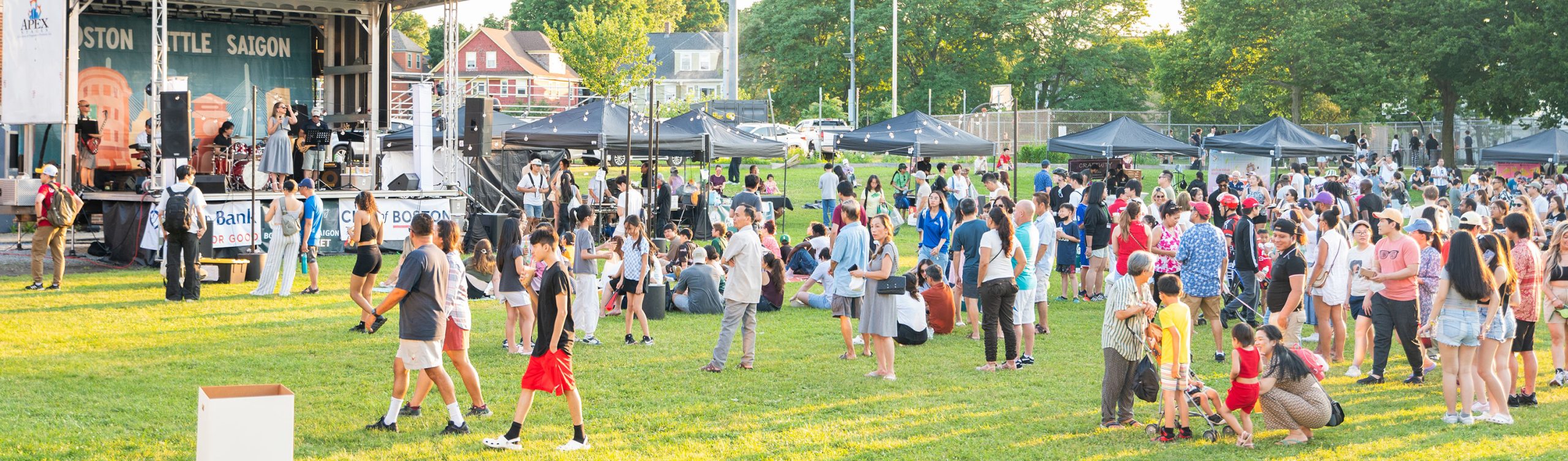
Examples may include but are not limited to: teaching residencies, concert series, workshops, festivals, fairs, performances, art walks, open studios, poetry readings, mural projects, oral history projects, fashion shows, gallery exhibits and openings, public installations, field trips, and productions of cultural works. Questions about whether your project is eligible for this grant? Contact us.
Are projects related to the creation of audio books, podcasts, documentaries, book publishing, or historical archives eligible?
Only if they are part of a creative experience that takes place during the grant period (i.e., a project might cover design and production work, but must also incorporate a public reading, launch, or exhibition as a culminating event).
Is virtual programming eligible?
Only if your target audience is in Massachusetts. Your organization must also meet the eligibility requirements of being based in Massachusetts and having a Massachusetts address.
Can my school or organization apply for an out-of-state field trip?
No. Eligible experiences must take place in Massachusetts, either in-person or virtually.
What if my project is touring or only partially takes place in Massachusetts?
You should only include the Massachusetts portion of your project in your application and the budget. The Massachusetts portion of the experience alone must meet the eligibility requirements, including $2,500 or $5,000 budget minimum (depending on the grant amount you’re requesting).
My experience isn’t intended for the general public. Is it still eligible?
Only if the experience is offered to all members of a specific community, such as people who share a cultural or heritage background, students, seniors, people with disabilities, or other portions of the public with a shared community identity. Eligible experiences do NOT need to be open to everyone or intended for all members of the general public.
For example:
- A cultural preservation workshop intended for people of a specific heritage is eligible, as it serves a broader community.
- A school-based or classroom project may be eligible even though the general public cannot attend, as the students represent a portion of the general public and are not a private group.
Experiences are NOT eligible if they are designed solely for the benefit of a specific person or a closed private group, such as a single family, friend group, workplace staff, or residents of a private residence.
Does our experience/activity have to be available for free?
No, but experiences/activities that are free to the public will be prioritized.
What if our experience/activity is only free for a certain population, but not for everyone?
If your experience/activity is only free for a certain population (i.e., seniors, or kids under 12) you will not be able to get prioritization points awarded for free activities.
What if my experience/activity has a majority of its programming during fiscal year 2027 (July 1, 2026 – June 30, 2027), but there is a little overlap into the next fiscal year?
If the majority (50% or more) of the publicly-available portion of your activity takes place July 1, 2026-June 30, 2027, you should apply for this cycle. The same experience/activity straddling the Agency’s fiscal years can only be funded once, in only one of the grant cycles. (An eligible experience/activity that is repeated annually can be funded in multiple grant cycles, as these are separate events/activities.)
We haven’t selected a date or location for our experience yet. Can I still apply?
Yes, if what you are planning meets the requirements for an eligible experience you can apply – even if you don’t have the details sorted out just yet. Note, if staff cannot verify an ORGANIZATION exists based on the application materials (including any links and/or uploads provided), the organization will be deemed ineligible.
What does ‘accessible to people with disabilities’ mean?
The Americans with Disabilities Act (ADA) is a civil rights legislative requirement that equitable provisions must be designed in your programs, services, and products. These considerations can and should be ongoing and improved over time. Access should be evaluated within physical and virtual sites to achieve integrated settings, effective communication, and reasonable accommodations.
Accessible creative experiences might include:
- Information on services provided, social narratives, and requests for accommodation.
- Microphones and amplified sound at a speaking program.
- Captions at a poetry reading. Printed poems at a poetry reading.
- Description of a walking tour that includes surface, slope, terrain, and distance.
- Audio-recordings of relevant exhibition materials. Training on descriptive language.
- Maps and wayfinding provisions at an outdoor festival.
- Working with Disability or Aging Councils for evaluating programs/events.
- Large print playbills. Playbills on personal devices.
For more info on Access and Inclusion resolutions contact Charles G. Baldwin.
Can my organization apply to perform at, take part in, or sponsor someone else’s event?
No. Eligible organizations must be responsible for the production, presentation or facilitation of the proposed experience. Organizations may not apply to participate in or present at an event that is produced by another organization. Serving solely as a venue, promotional partner, or corporate sponsor is not an eligible experience.
How do I describe my role in a project that has many partners and is widely available?
Here are some examples of how partners on a project may describe their role, should one of them choose to apply on behalf of the experience.
SCENARIO #1:
My role is to run a workshop during a larger Community Day event.
OR if their partner was applying:
My department of the municipality is producing a Community Day event with arts and social service organization partners.
SCENARIO #2:
My role is to program activities at a senior center and I am paying to host a workshop in the facility.
OR if their partner was applying:
My role is to facilitate workshops for the elderly and are partnering with a local facility.
Eligibility: Applicant Organizations
How can I tell if my organization is incorporated in Massachusetts?
You may search for your organization using the search function on the Secretary of the Commonwealth’s (SOC) Corporations Division’s website. When you find your organization, you can click on that record to see the status of your incorporation and any related filings. If your organization’s status is listed as revoked or dissolved on the SOC website, we will be unable to award you a grant. Your organization may also be at risk for liability and other issues, and you should work with the SOC to address it as soon as possible.
Do I need to have a 501c3 to apply?
No. Organizations do not need to have federal tax-exempt status to be eligible for this program. If your organization is incorporated or registered in the state of Massachusetts and not dissolved or revoked, you are eligible. If your organization is not incorporated or registered in Massachusetts, you may apply using a fiscal agent.
My organization is in a state other than Massachusetts? Can we apply?
Only if your organization meets the following additional requirements:
- Nonprofit and for-profit entities need to be registered as a Foreign Corporation with the Secretary of the Commonwealth of Massachusetts and have a Massachusetts address.
- Unincorporated organizations and other creative businesses must have a Massachusetts address and conduct the majority of their organization’s programming in Massachusetts.
- The proposed experience must be in Massachusetts.
Do we need to be a federally recognized tribal government to apply?
No, Native American and/or Indigenous organizations are eligible with other legal statuses as well, including for-profits, nonprofits, and unincorporated organizations.
Are DESE Adult Education (AE) Providers and other types of schools eligible?
Yes, they are. Because AE Providers include nonprofit community-based organizations, religious institutions, and local governments when you complete the eligibility quiz, do not select the PreK-12 school option. Select the organization type that matches the AE provider’s status, i.e. nonprofit, government entity, etc.
My school does not have a DESE ID 25-26 can we apply?
Only if your organization is eligible as another applicant organization type (i.e. is a nonprofit or for-profit school, registered to do business in Massachusetts). In this case, do not select K-12 school in the eligibility quiz. Instead select the legal status that aligns with your school.
How do I apply for my school’s club, department, PTO, or booster organization?
Groups that exist under a larger organization, such as a department or club, should apply AS the school, who will need to complete the grant contract package and accept the funds, if you are awarded a grant. Do not create your own account in our grants management system. Only one application is allowed from each organization, so you may need to coordinate with other departments or clubs to decide who will apply.
If your organization has its own legal status, separate from the school, you may register as your own organization and apply to receive a grant directly. Please note, any specific and limited audience (i.e. a school) can only receive one grant per cycle. (i.e. a PTO or the school should apply, not both, even if it’s for different activities.)
Can I apply as an individual?
No. Individuals cannot apply to this grant program.
A group of individuals working together (aka an unincorporated organization) and individuals that operate creative businesses as sole proprietors or single member LLCs are eligible to apply, if they have an eligible fiscal agent in place at the time of the application who is willing to accept and administer the grant award on their behalf.
My organization operates as a sole proprietorship, or a single-member Limited Liability Company. Am I eligible?
Only if your organization has an eligible fiscal agent at the time of the application who is willing to accept and administer the grant award on your behalf.
I am an artist. Can I apply for a grant on behalf of an organization to present my work at their venue?
No, only authorized representatives can register as an organization. Authorized representatives have permission to act on the organization’s behalf, either as a member of the organization’s board or staff, or as someone duly authorized in writing by the organization to register as a contact for the organization to submit applications (i.e., grant writer, contractor, volunteer, etc.).
Individuals who act on behalf of an organization without permission, may result in the withdrawal of any/all applications submitted, cancellation of any/all grants awarded, and the removal the individual’s profile from the organization’s record in our grants management system.
Creative businesses like single member Limited Liability Companies and sole proprietors can identify partners in their creative programming, if applicable, but should register and apply as their own organization.
Can religious organizations apply for funding?
Yes, religious organizations or groups with religious affiliations are eligible to apply if the experience/activity meets all other eligibility requirements and does not include activities that are ‘inherently religious’ such as religious worship, instruction, and/or proselytization.
Can a state-designated Cultural District apply for funding?
No. All state-designated Cultural Districts receive a separate noncompetitive grant from Mass Cultural Council. This is true for Cultural Districts that are incorporated, and for districts managed by municipalities or independent 501(c)3 organizations.
501(c)3 organizations that also manage a Cultural District: The 501(c)3 organization may only apply for Creative Experiences if it has operations that are independent of the Cultural District. Their application can mention that they are the manager of the Cultural District but should not include the activities of the Cultural District as activities of the managing organization. If the Cultural District and the 501(c)3 are substantially the same organization (no separate programs/activities) they are not eligible.
Municipalities: A municipality can apply to Creative Experiences for an experience/activity other than a Cultural District, if it has activities under another entity/organization. They should start a profile in our grants management system, identifying the municipality as the parent organization.
Can I apply for and/or receive other Mass Cultural Council grants if I apply for FY27 Creative Experiences?
Yes, but it depends on which grant. You can apply for YouthReach and Creative Experiences, but you would only receive one of the grants. We would award the larger grant.
If you receive FY26 Cultural Investment Portfolio, Operating Grants for Organizations, Cultural District Investment, or Gaming Mitigation Fund grants you cannot apply for FY27 Creative Experiences.
FY27 Creative Experiences will not affect your Local Cultural Council or a Cultural Facilitates Fund applications.
What does it mean to apply with a fiscal agent?
A fiscal agent is an organization that agrees to act as the legal and contractual representative of the unincorporated group. They can provide a variety of services as part of the agreement, but the most important is that they maintain supervision over the funds, making sure that they are used for the purpose of the agreement.
Grantees using a fiscal agent will not be paid directly, the fiscal agent will complete the contract and receive the payment on the grantees’ behalf.
Eligible fiscal agents must have active tax-exempt status with the IRS and be registered to do business in Massachusetts – meaning they are listed in the Corporate Division’s Business Entity database (not dissolved or revoked) or registered with the Office of the Massachusetts Attorney General’s Nonprofit Organizations/Public Charities Division. For the purpose of this program, Massachusetts municipalities are also able to serve as an applicant’s fiscal agent.
Can I use a fiscal agent that isn’t in Massachusetts? i.e. a national nonprofit?
Only if the nonprofit is recognized by the IRS as tax exempt and registered with the Office of the Massachusetts Attorney General’s Nonprofit Organizations/Public Charities Division.
My fiscal agent receives other funds from Mass Cultural Council programs. Can they still be my fiscal agent?
Yes. Organizations receiving grants from other programs at the Mass Cultural Council (i.e. the Cultural Investment Portfolio or Operating Grants for Organizations) can serve as a fiscal agents for another applicant organization in this program, if they meet the requirements to be an eligible fiscal agent.
What is the difference between a fiscal agent and a parent organization?
A parent organization is the larger organization which coordinates, supervises, or exercises control over policy, fundraising, and expenditures at your organization, while fiscal agents only agree to act as the legal and contractual representative for an organization. If your organization is a program of, department of, or a branch of a larger organization, then that organization is your parent organization. A parent organization and their ‘child organization’ share the same tax identification number as well.
Examples of child and parent organizations may include a museum at a university, the parks department of a city or town, and the Massachusetts branch of a national organization.
Can each organization submit more than one application? Can multiple applications be submitted by related organizations or for the same experience?
No, each organization can only submit one FY27 Creative Experiences application. Additionally, each experience will only be funded once per cycle. If multiple applications are submitted for the same project, priority will be given to the primary producer, and/or the highest-scoring application will be kept, while the others will be deemed ineligible.
What are some examples of applications that might not get funded because they overlap?
FY27 Creative Experiences grants are limited to one grant per organization, per event, and per specific limited audience.
Please be sure to communicate with any organizations that you work with, or other people that work in your organization or its departments/programs, to be sure that you do not submit two applications that interfere with each other’s eligibility.
If we do find instance of an overlap, the application from the primary producer of the experience or the highest scoring application will be kept, and the others deemed ineligible. Some common examples of overlapping applications include:
- Per organization: The local orchestra submits two different applications for two different performances.
- Per event: A dance company and a band both submit applications for their co-produced music festival.
- Per audience: A school and its PTO both submit applications for different teaching residencies for the students.
How does the grant limit apply to city or town departments, schools, and other municipal entities?
If the parent organization is a city or town, each department or entity within that city or town can apply separately. For example, both the ABC Town Public Library and ABC Town Elementary School may each apply and receive grants.
However, only one application will be considered from the same town department or school. If there are multiple applications submitted from ABC Town Elementary School for different programs, the highest scoring application will be kept, and the others deemed ineligible. To avoid this situation, we recommend that you let your town/school’s fiscal or grant office know if you plan to submit a Creative Experiences application.
If we received a grant from a Local Cultural Council, does this count as being ‘previously funded’?
No. If you only received funding from Local Cultural Councils, your organization won’t be considered as receiving previous funding from Mass Cultural Council.
Why are school applicants going on field trips asked to put the city or town of their school rather than the city or town of the experience?
We ask this question to assign priority points for experiences taking place in priority communities. However, we recognize that an experience like a school field trip to a neighboring town’s museum, still primarily benefits the school population. Therefore, these priority points are based on the city or town that the school is located in. A reminder that only in-state field trips are eligible for this program.
Review Process & Funding Prioritization
How do the funding priority points shape the funding list?
We use funding prioritization points to calculate a score for each application. We create a list of applications from highest to lowest score and fund down that list proportionate to the geographic distribution of applications, until we run out of grant funding. Funding priorities are DIFFERENT from eligibility. Even if you meet none of the funding priority points, you are still eligible to apply.
How can my Creative Experience get points for funding priorities?
While some of the points are based on an organization’s self-identification as a BIPOC-Centered Organization or whether the applicant has been funded by Mass Cultural Council in the past, there are funding priorities that your application can meet through the design of your experience. These include:
- Hiring and compensating a Massachusetts artist, scientist, or humanist.
- Making your experience free to the audience and therefore more financially accessible to the audience, or having your organization participate in the Card to Culture Program.
The project administrator/manager is also an artist, should we include them in the application/budget as a Massachusetts artist?
No, if they are only acting as a project manager/administrator and are not acting in their capacity as an artists, they are not considered a Massachusetts artist/humanist/scientist for the application and funding priority.
I submitted an application for the BIPOC (Black, Indigenous, and People of Color) Centered Organization self-identification or Card to Culture, but the prioritization points aren’t showing up yet. Should I still submit the application?
Yes. Mass Cultural Council staff will be reviewing BIPOC-Centered Organization and Card to Culture applications. Once those reviews are complete, the points will be added retroactively in our grants management system.
Online Application
How do I access the online application?
Start by registering in the Agency’s grants management system as an organization if you are applying for a grant on behalf of an organization, school, city/town, or another group. In this case, the organization is the applicant and grant recipient, and you are the primary contact for the application.
Typing your organization’s name into the ‘Organization Name’ field in the grants management system will prompt a list of organizations already registered in our system. Select your organization from the list, and then complete your contact information. If your organization is not listed, follow the directions to add your organization information and your contact information to register your organization.
To see if you already have a profile in the grants management system, log in and click ‘Forgot password?’ and enter your email address. If the email you entered matches the one in our system, you will be sent an email from ‘[email protected]’ with instructions for resetting your password.
Why can’t I see the ‘Creative Experiences’ under ‘current opportunities’ in the grants management system after I’ve logged in?
Only organizations are eligible to apply for Creative Experiences grants. If your profile is set up as an individual applicant account, you cannot see the grant opportunities meant for organizations. Individuals are not eligible to apply to this program.
If you are also an authorized representative of an eligible organization, you should login with the account associated with that organization. If your organization does not already have an account, you will need to register and create an organizational profile using a different email address than the one associated with your individual account in our grants management system.
After you login to your organization’s account or register as an organization and set up your password, the grant opportunity will display under ‘current opportunities’.
Please note that seeing grant programs in the ‘current opportunities’ section is not confirmation that your organization is eligible for that grant program.
How do I know if I have an individual account or an organization account in the grants management system?
- If you have an individual user account, your portal displays ‘My Profile’.
- If you have an organization account, your portal page shows ‘My Profile’ and ‘My Organization Profile’.
How do I know if my application has been successfully submitted?
You should be able to see a ‘Congratulations’ header at the top of your submitted application on the grants management system, and will receive a confirmation email with a copy of your submitted application.
Budget
What are the minimum expense requirements for an experience/activity?
The minimum expense requirement depends on which grant amount you are requesting. Applicants can apply for $2,500 or $5,000. The minimum expenses must be equal to or more than the grant amount requested.
If your proposed activity exceeds $2,500 or $5,000 in expenses, you must report the full amount in your application. If awarded, the grant amount will be either $2,500 or $5,000, regardless of the total project budget.
What can I include in my budget?
Any cost associated with the experience/activity can be included in the budget, including all direct costs, indirect costs, overhead, transportation, materials, and planning time.
Experiences/Activities must have a minimum of $2,500 or $5,000 in cash expenses, depending on the grant amount requested. This includes the full cost of the project, with no restrictions on overhead or indirect costs. If your proposed activity exceeds $2,500 or $5,000 in expenses, you must report the full amount in your application. If awarded, the grant amount will be either $2,500 or $5,000, regardless of the total project budget.
Can I include capital expenses in my budget?
Only if they are directly related to the arts, humanities, or science experience you are applying for.
Can Creative Experiences funding be used to cover administrative expenses, such as food and beverages, supplies and materials, and payment of staff?
Yes, there is no limit on overhead or indirect costs regardless of the size of the project. However, the costs must be directly associated with the activity you are applying for under this grant program. For example, a budget item for staff time should only include the staff time required for this specific experience.
Do I enter my whole budget into the application, or just what I’m going to spend the money on?
Your budget should include the full cost of the experience, not just expenses you are asking the grant program to cover. This means that if the budget exceeds the requested grant amount, you should still include the full cost in your application. The ONLY exception is if your program takes place in states, in addition to Massachusetts. Then, only put the Massachusetts portion of your experience into the budget.
Grant Decisions & Payment
How many grants will be awarded?
The number of grants awarded through this program is dependent upon the Agency’s FY27 state budget appropriation and our FY27 spending plan which is expected to be approved by the governing Council in August 2026. In FY26, Creative Experiences received nearly 1,560 applications, and awarded 710 grants. This program receives a high volume of applications, and not all eligible applicants are guaranteed funding.
How do I check the status of my application?
We anticipate notifying applicants about the outcome of their application in September 2026, and will update the timeline in our program guidelines if that changes. You can also check the grants management system anytime and see the status of your application in one of the following buckets: ‘In Progress’, ‘Submitted’ , or ‘Approved/Declined’. You are also welcome to contact us with any questions.
If funded, when would we receive the grant?
If your grant has been approved, you will receive an electronic funds transfer after your contract with us is fully executed. This is usually 4-6 weeks after Mass Cultural Council receives your completed grant contract package. We expect to be able to send contracts to grantees in late-September through October 2026. Please note: This timeline is subject to change, and awardees need to complete a multi-step contracting process before funds can be disbursed. Applicants with funded activities happening before that time may be paid retroactively.
Can we hold over funds for another related experience?
You are unable to hold over funds. Grant funds need to be spent on your proposed projects unless discussed with Mass Cultural staff after the approval process.
How do we request a modification to our original proposal and description?
Reach out to the Creative Experience’s team with any requests to significantly modify your original proposal. Staff will then make an internal note on your application. You will fill out the final report with updated details regarding your new project or festival.
We are not able to hold our experience before the end of the grant period (June 30, 2027). Do we lose our grant funding?
You have a few options:
- Discuss with staff about a project modification that will still happen within the grant period. Staff will make a note on your application, and you will provide details about your updated Creative Experience on the final report.
- If your project or festival needs to be postponed until after June 30, 2027, you will fill out the final report after you conclude your program, but you will not be eligible to apply for the FY28 cycle.
Still Have Questions?
Technical questions about the online application or grants management system? Contact our grants team.
Programmatic questions about application requirements? Email our program staff or call 617-858-2821.
Are you a grant recipient wondering about the status of your contract or payment? Review the contracts and payments FAQ, or contact our contracts office.