
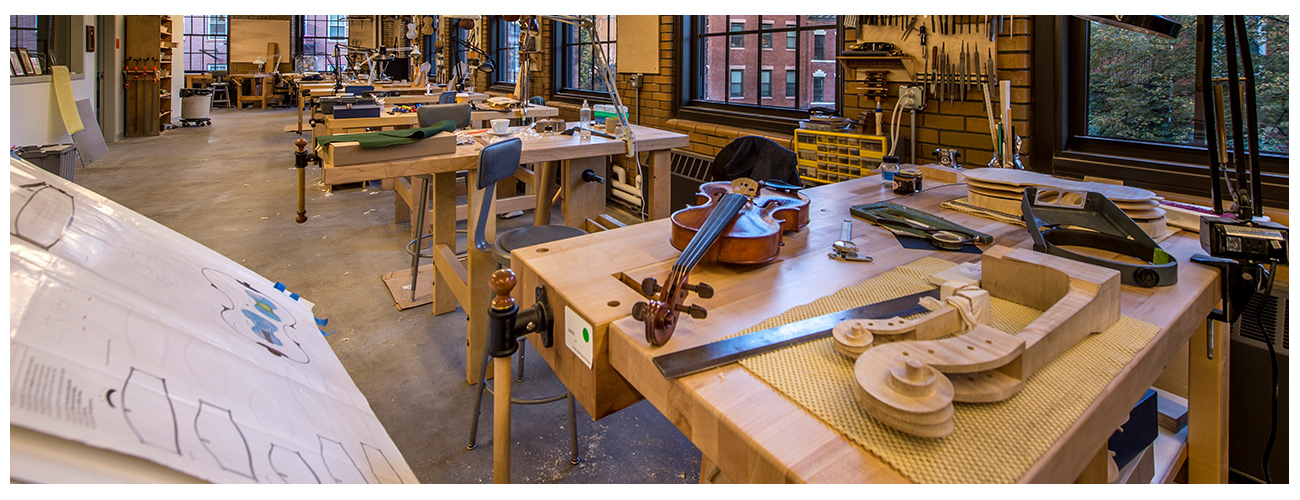
Adaptive Reuse of Buildings
Since 2006, Mass Cultural Council has been committed to supporting the development of vibrant creative spaces through consultation services and Cultural Facilities Fund (CFF) grants. Our state-wide perspective gives us the opportunity to see development trends in geographically distant communities but with similar stories.
We’ve developed a series – Adapting Public Buildings for Creative Uses – which includes interviews, case studies, and webinars with the people who organized, built, and now operate numerous transformed municipal spaces as community art centers. In each case we discuss the step-by-step process of transformation.
To supplement our case studies, a webinar hosted by MassMunicipal Association was held in June 2025 where CitySpace folks and others doing this work shared their experiences.
The 204 Cultural Arts Municipal Building
Harwich, MA
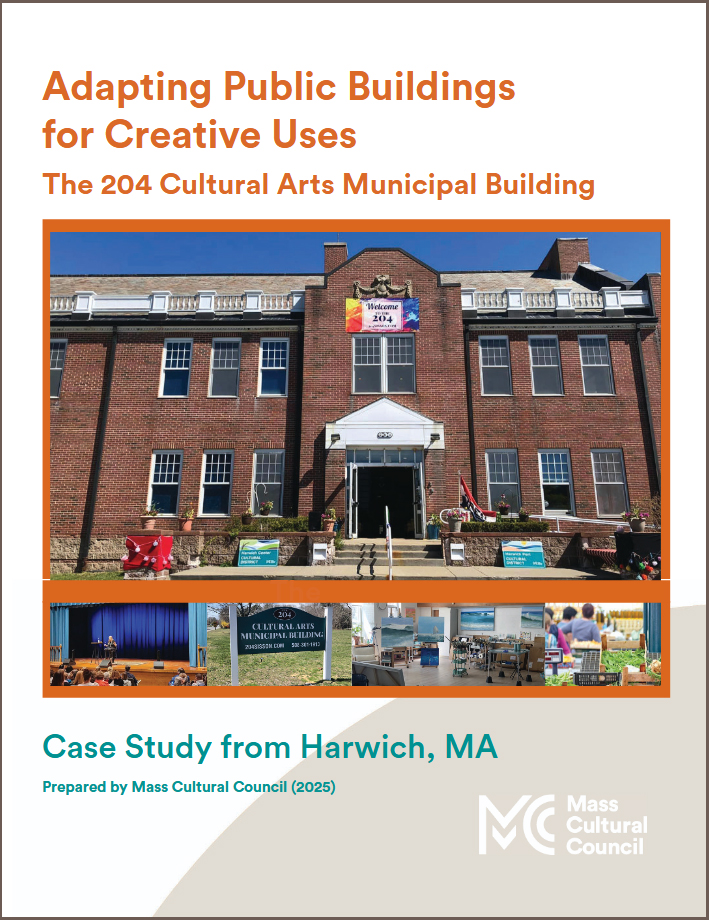
The 204 Cultural Arts Municipal Building in Harwich, MA is a model of successful adaptive reuse. After the local middle school closed, the town engaged in a thoughtful, multi-year planning process that prioritized community input, fiscal sustainability, and cultural development.
The result is a vibrant arts center with 36 artist studios, shared creative spaces, and public amenities, all managed through a financially self-sustaining model.
Supported by a dedicated cultural affairs department and embraced by multiple town departments, The 204 demonstrates how surplus municipal buildings can be reimagined to meet community needs, support local economies, and strengthen civic identity.
CitySpace
Easthampton, MA
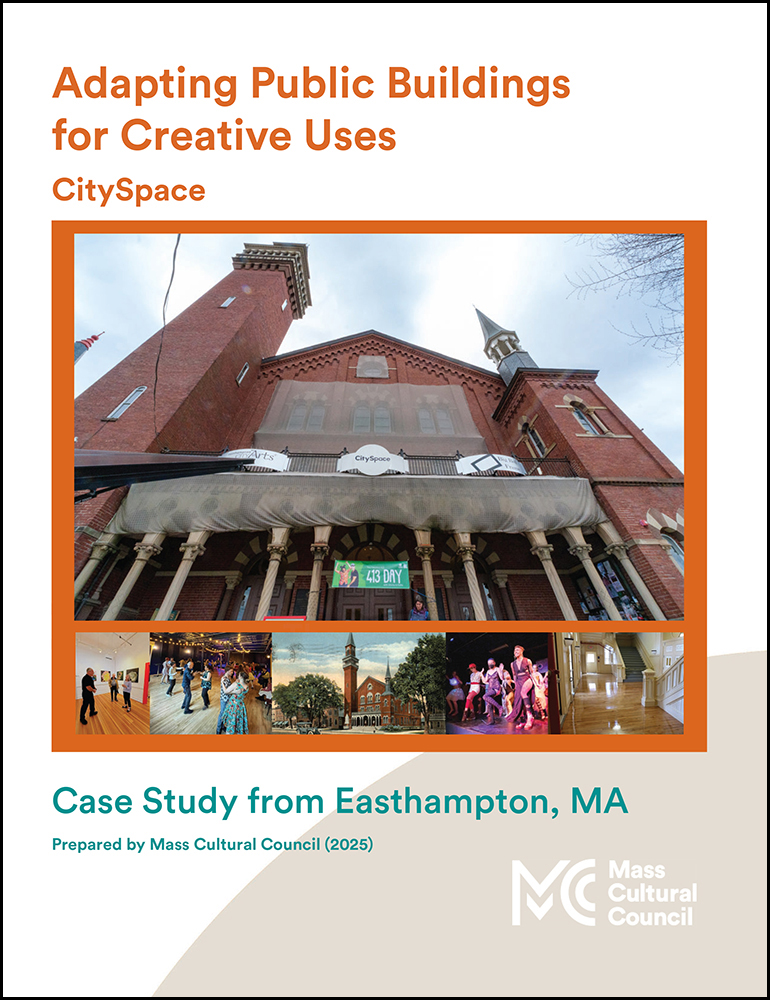
Mass Cultural Council staff first started talking to CitySpace in 2011 about their Town Hall being transformed into an arts center. By 2013, they received their first Cultural Facilities Fund grant which supported a conditions assessment of the building or as we call it a Systems Replacement Plan. As with many projects, the next step was a planning grant for preliminary architectural plans for the building’s second floor which was closed to the public. Then in 2017 the Agency started making CFF capital investments and in 2025 CitySpace had an official ground breaking for the second floor performance space. As you will see from this case study, this is a long game!
The following case study is based on firsthand accounts from the key figures behind CitySpace’s evolution, including Burns Maxey, the organization’s President; Mike Tautznik, former Mayor of Easthampton and current CitySpace Treasurer; and Ed Check, a Co-founder and board member. They provide practical insights and guidance for those considering the adaptive reuse of historic spaces within their own communities. Their experiences highlight the importance of civic foresight, community engagement, and strategic planning in preserving and repurposing public buildings for creative uses.
Mother Brook Arts & Community Center
Dedham, MA
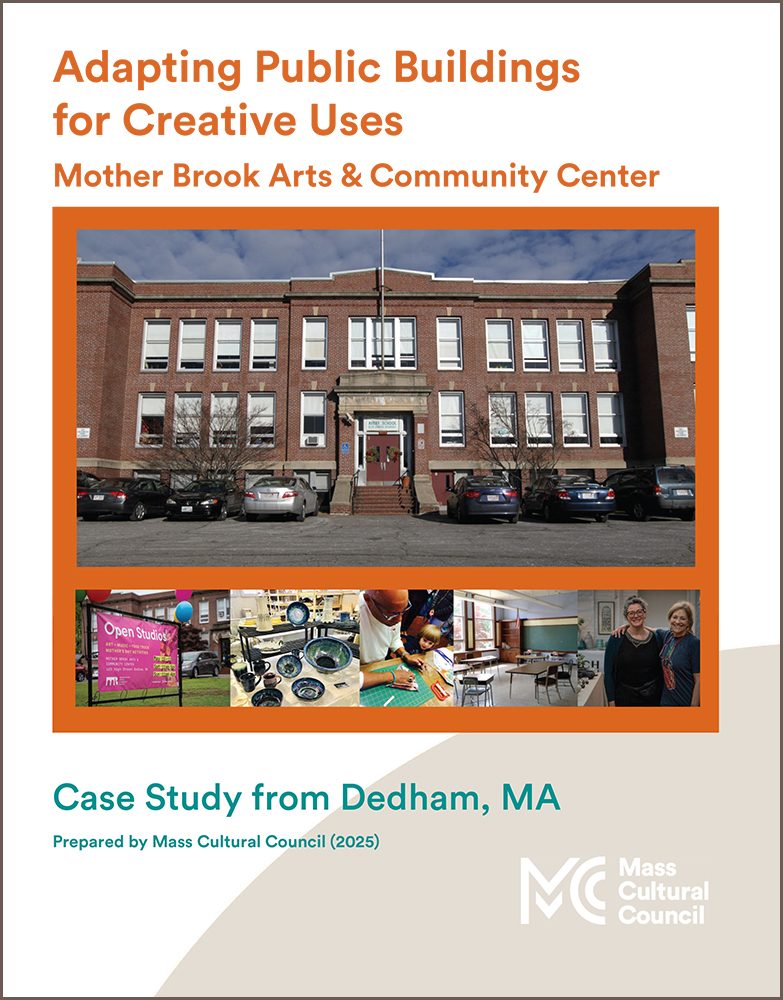
In 2008, Karen O’Connell, the Economic Development Director in Dedham, reached out to Mass Cultural Council inquiring about the possibilities of using a surplus public school as an arts center. Immediately we began looking at examples of former schools now serving as artist spaces in Massachusetts. Connections were made to The Umbrella in Concord, ArtSpace Maynard, and the Munroe Center for the Arts in Lexington – all former schools and willing to help Dedham understand the business model and process.
These pioneer projects each offered a unique template on how the partnerships between artists and municipalities formed and the steps taken to create a public space for artists to work, perform, teach, and gather.
Five years after our initial conversations a lease was signed for the Avery School to become the Mother Brook Arts & Community Center operated by a newly formed nonprofit.
Now, Mother Brook with its 17 artist studios and 2 shared studios (printing and ceramics) can be included as an example for other cities and towns who might be interested in learning how to adapt a municipal building for creative purposes.
Our case study and interview (below) with Erin Becker, Executive Director, and Paul Reynolds, former Select Board Member, follows the origin story of the project, the community members championing the idea, the multi-faceted planning required, and the operational/governance model chosen by Mother Brook.
Listen to the Interview
Cogswell ArtSpace
Haverhill, MA
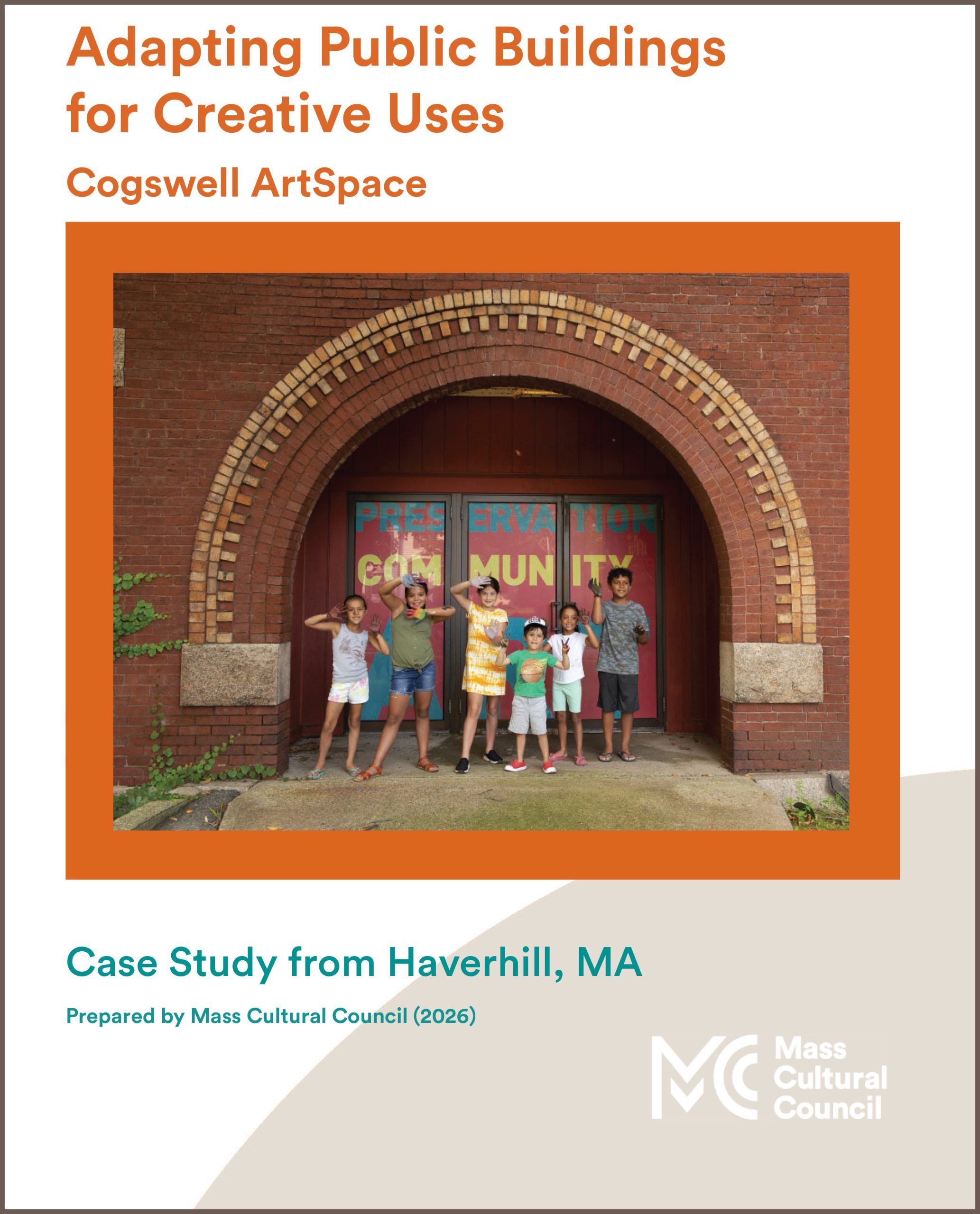
This is a story of persistence, adaptability, and patience.
In late 2013, Danielle Smida, Chairperson for Creative Haverhill, envisioned turning a schoolhouse that had sat vacant for a decade into a thriving community art center. Drawing on her experience with commercial real estate, Danielle knew that a professional conditions assessment is an essential first step in making a fact-based decision to lease or acquire a building.
In early 2014, Mass Cultural Council began discussing the project’s sequencing. Through a grant from the Cultural Facilities Fund (CFF), a third-party professional assessment was conducted. The results confirmed what the community hoped: the building was a prime candidate for preservation and adaptive reuse.
With the assessment in hand, Danielle was joined by seasoned arts administrator Erin Padilla. Together, they began the complex work of community organizing, responding to RFPs, fundraising, and planning for future programming and design.
Two years after our initial conversations, the City of Haverhill awarded Creative Haverhill a three-year option to purchase the former school. This period was a masterclass in adaptability as Danielle, Erin, and the Haverhill community navigated the challenges of implementing a long-term vision. At the end of that three-year option, the Cogswell ArtSpace was officially purchased from the city.
As of 2026, the first phase of upgrades is complete. The current focus has shifted to critical infrastructure, including ADA compliance, plumbing, bathroom renovations, and a modern sprinkler system. The Cultural Facilities Fund has supported this journey through multiple grants covering planning, acquisition, and half the cost of a new elevator. Today, the team is actively fundraising to secure the remaining match needed for the elevator installation—a final “missing piece” for full accessibility.
The timing couldn’t be more critical. Even as renovations continue, demand for creative space in Haverhill is rising. Their current 495-square-foot downtown incubator space is consistently over capacity, proving that the need for a fully realized Cogswell ArtSpace remains strong.
The case study and interview (below) with Danielle Smida, Chairperson of Creative Haverhill and Erin Padilla, Director of Creative Haverhill follows the origin story of the project, the community members championing the idea, the multi-faceted planning and fundraising required, and the management/operations model chosen by Cogswell ArtSpace.
Listen to the Interview
Be a Part of the Creative Space Development Network Accelerator (DNA)
Are you preserving, advocating for, or developing creative space in your community? Join our monthly Zoom sessions! We’re bringing together artists, musicians, cultural organizations, funders, and developers to share strategies and support.