Power of Culture Blog
Centering Visual Artists in Local Business Partnerships
Community-driven directory of 1,200+ Massachusetts visual artists launched

Dawn Heinen, Digital Communications Manager
Artist and curator Shelby Feltoon and restaurateur Holly Heslop on shaping meaningful local collaborations
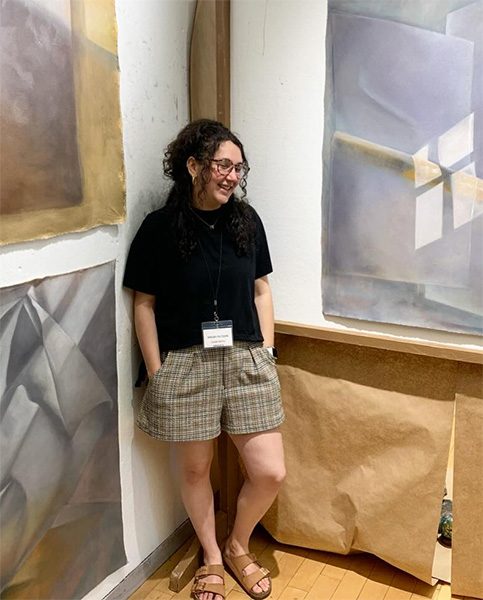
As part of our series on Creative Entrepreneurialism, we spoke with Shelby Feltoon, a practitioner, educator, and facilitator who curates for Cambridge Common restaurant; and Holly Heslop, co-owner of Cambridge Common and Lizard Lounge.
Tell me about yourself and how you came to this curator role. What kind of business are you consulting with?
Shelby: I came to Boston years ago for undergrad and earned a BFA in Fine Arts. Since then, I’ve worked in a variety of roles, mostly tied to education. My interest in curatorial and installation work began in college when I served as Suffolk University’s gallery assistant during my senior year. I learned how to hang artwork, plan space, and observe the dynamic between curator and artist.
Since then, I’ve done freelance installation work, but I primarily teach undergraduate courses at Suffolk and am working on my MFA. I’m immersed in the art world as a practitioner, educator, and facilitator.
My position [as curator for Cambridge Common] came to me through word of mouth. A friend who held the role passed it along, and I’m part of a lineage of Suffolk Fine Arts students who’ve curated at the restaurant. I’d previously exhibited my own work there, so I was familiar with the space.
Cambridge Common is a very neighborhood-oriented restaurant. It’s pretty cozy, casual place to kind of hang out at the bar or the restaurant. There’s a second half of the business downstairs – the Lizard Lounge, a venue for performance.
The owners of Cambridge Common and another restaurant – Christopher’s, which closed a few years ago – supported an art program in both spaces for decades.
Holly and her husband [the restaurant co-owners] are very tapped into the fact that the arts are a major part of the fabric of the Cambridge community.
I think especially because they run a music venue that’s connected to the restaurant, bringing in the visual arts component was a natural extension of that.
How did the decision to include artwork come about 30 years ago?
Holly: When we opened Cambridge Common, we had already been showing local artists at Christopher’s for years, so we were inclined to continue what had been a wonderful experience.
Unlike Christopher’s, Cambridge Common had lots and lots of wall space which really lent itself to artwork, so we knew that the impact would be significant.
One of the things we love about working in Cambridge is the wealth of creativity and talent that surrounds us, and it’s been a joy to be able to tap into that.
What about the exhibits?
Shelby: We rotate exhibitions every six to eight weeks. We focus on local artists from the Greater Boston area to showcase the talent in our community.
How do you find artists?
Shelby: Mostly through Instagram and word of mouth. I also look at students in MFA programs at local colleges – like BU and Brandeis – since we primarily show paintings. After living and working here for more than a decade, I’ve built a strong network and often reconnect with artists who’ve previously shown at the restaurant.
Occasionally artists reach out directly, but more often I initiate contact. We also have returning artists. Our current artist [at the time of this conversation] is showing for the fourth or fifth time.
What’s been most challenging about curating in this space?
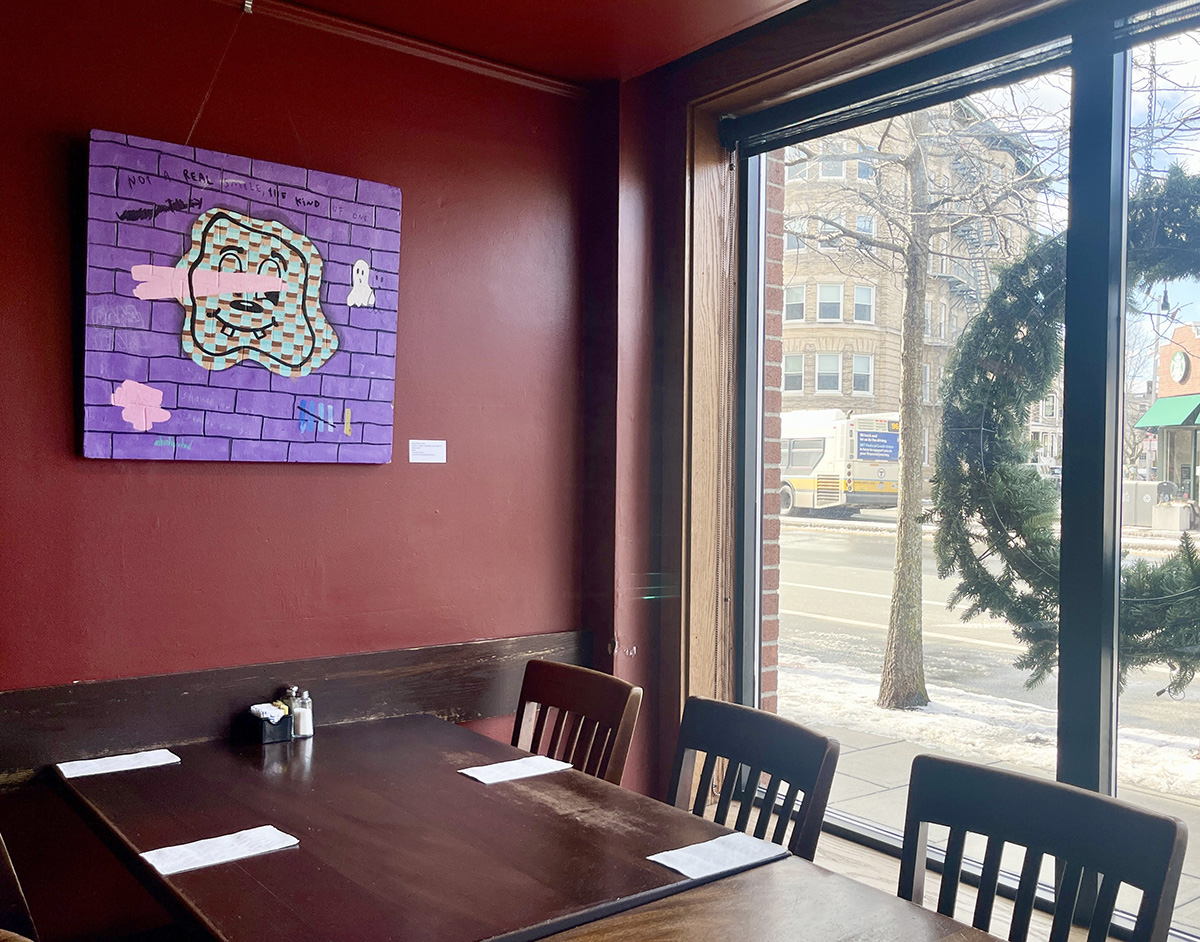
Shelby: Finding artists who meet our constraints. The restaurant has brick walls, so we can’t drill into them. We hang work from molding using fishing wire through D rings. We don’t show photography or work behind glass because of lighting and glare. The work must be safe to hang and sturdy. So, there are real physical limitations to what kind of work can be shown in the space.
We also consider content. Abstract work doesn’t always resonate with diners as strongly as representational or figurative work. Subject matter must be appropriate for a family-friendly environment. Holly is down to show edgy work, but it has to align with the values of the space.
Because of these factors, the pool I can draw from narrows significantly. I know many artists whose work I admire, but far fewer meet all of these requirements.
Has the role allowed you to push boundaries?
Shelby: Yes. Holly has strong instincts and a long-standing commitment to the program, which gives me room to advocate for artists. For example, we showed Andy Lee, a fiber and text-based artist. He was one of the Boston Triennial artists. There’s no real, like, imagery in a lot of the work. It’s mostly text. I was able to make a strong case for his work and Holly was receptive to it.
He created a body of work specifically for the exhibition that incorporated text within dinner plate imagery, conceptually tied to the setting. Andy priced his work really well and sold three pieces during his six-week show. (The restaurant doesn’t take commission on sales. Holly sees the program as community support.)
A really great aspect of the job is that Holly appreciates – as do I – work that’s engaged with the contemporary dialogue. We really don’t show work that is overly innocuous.
The work I’m showing is pretty rigorous in terms of contemporary painting, and that is a challenge and privilege for me. It’s also a credit to Holly and her commitment to this program over all these years.
I’ve been able to make a case for artists that I think would be really interesting that are maybe a little bit less conventional in the tradition of like what we’ve shown.
I love that too, because then folks who might not consider themselves gallery goers or in the conversation with contemporary art are having dinner with their family and there’s something next to them they wouldn’t have seen otherwise.
What impact has the program had on the space?
Holly: The artwork that we show absolutely transforms the physical space and brings so much enthusiastic feedback from customers and staff alike. It is typical for artists to sell some – sometimes many – of their pieces (we’ve even had the occasional sold-out show), and there’s such gratification in that.
It’s not uncommon for us to hear from artists that their career was launched when they hung their work at the restaurant. That means so much to us.
In terms of bottom line, it is probably best described as a labor of love. We carry the liability insurance and take no commission from the artists. That said, it’s a small price to pay for the part that the artwork plays in creating the ambience of the restaurant.
Shelby: I install on Friday mornings before lunch service, and staff often express excitement about new work. Servers tell me diners comment on it and ask questions. That feedback can inform future curatorial choices.
The fact that Holly has sustained the program for all these years speaks to its value within the business.
What do you wish artists knew about working with small businesses?
Shelby: First, that these opportunities exist. I’d welcome more outreach from artists – it would make my job easier!
It’s an unconventional venue, but that creates an interesting artistic challenge for artists who are open to playing with a lot of different imagery and frameworks. This can create a really unique challenge for them as a maker.
Don’t be afraid to have an artistic voice and still go seek out getting your work shown in these businesses.
What advice do you have for small businesses thinking about working with local artists?
Holly: I would encourage small businesses to work with local artists. In addition to keeping the atmosphere of an establishment vibrant and fresh, customers are engaged and supportive. In addition, there is the satisfaction of knowing that a local show can really make a difference to the artists.
(Fun fact: one of the artists whose work we showed early on created the mural that still hangs in the restaurant 30 years later!)
Shelby: The most important step is simply to begin. It helps to find someone with the skill set and interest to run the program. In my case, the time commitment is manageable, about five to eight hours per month. Most of my research and outreach happens independently, and installation takes under two hours every six to eight weeks.
Local universities with art and design programs are excellent resources. Reaching out to department chairs in studio art programs is often more effective than contacting administrative offices. There may also be someone on your own staff with relevant skills.
Spaces like First Fridays in the South End are where many artists and curators gather informally. Museum networks are another strong community hub. I’m also involved with Behind VA Shadows, a grassroots window gallery project in Harvard Square that amplifies current and former museum workers. These networks create natural curatorial ecosystems.
Could this model expand into universities?
Shelby: Absolutely. Client-based projects are common in graphic and interior design programs, where students work with real businesses. Studio art programs sometimes separate professional practice from applied experience. Integrating real-world curation projects into coursework could bridge that gap.
Often professional practice classes focus on artist statements and websites—important, but theoretical. Applied curatorial partnerships could provide valuable hands-on experience.
Mass Cultural Council is working with Mass Restaurant Association and Mass Lodging Association on bringing the local artist community to the hospitality community.
As part of this effort we’ve created a Partner with Local Artists Toolkit, with practical advice for businesses interested in forging connections with visual artists in their community.
The toolkit also offers an introduction to businesses to take advantage of CreativeGround.org, a dynamic regional directory that celebrates the vital work of New England’s creative people and places. A project of New England Foundation for the Arts (NEFA), CreativeGround is a free, community-generated tool.
We encourage artists who aren’t already listed to create a profile on CreativeGround.org.